Toward a Future Where People and AI Work Together
KOKUYO × TIGEREYE Joint Patent and
the “OFFICE AGENTIC AI” Project
About the Patent Application (No. 2025-180014)
Market Background and Challenges
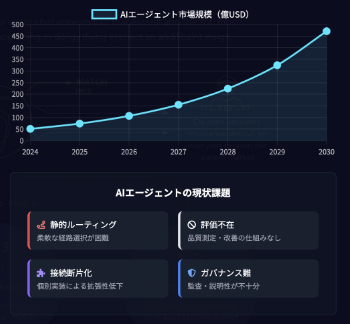
The AI agent market is expanding rapidly and is projected to grow from approximately USD 5.1 billion in 2024 to about USD 47.1 billion by 2030 (CAGR: ~44.8%).
By 2025, companies will enter an era in which over 100 agents collaborate in operations, and AI will take a central role in real work—ushering in the “agent era.”
However, existing systems face challenges such as static routing, lack of evaluation, and fragmented integrations, making it difficult to achieve optimal agent collaboration and governance.
To address this, we propose a new AI ecosystem where AI selects, learns, and improves other AI—enabling smarter collaboration.
AI Selects AI.
A New Intelligence Structure, From Evaluation to Collaboration.
Three layers work together so AI can autonomously form teams and evolve through continuous learning.
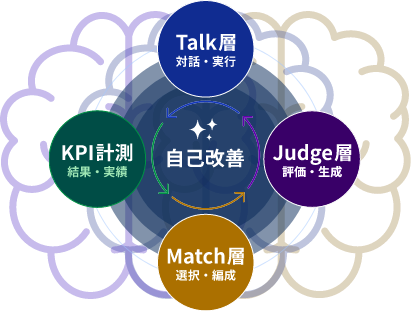
This patented technology (Application No. 2025-180014) is a three-layer autonomous system centered on the concept of “AI evaluates, selects, and learns from AI.”
AI agents understand each other’s strengths, form optimal teams, and share tasks based on context. Over time, they evolve into a smarter AI foundation.
With this mechanism, AI dynamically selects the best-performing combinations without human-defined rules. Each agent learns from execution results and accumulates collaboration data with other agents, continuously improving accuracy, efficiency, and adaptability.
1. Talk Layer
Conducts structured dialogue compliant with MCP (Model Context Protocol), attaching metadata such as purposeID / agentID / confidence / timestamp. It organizes AI-to-AI conversations with context to ensure reliability and reproducibility.
2. Judge Layer
Evaluates AI outputs across eight metrics (achievement rate / factuality / coverage of evidence / constraint compliance, etc.) and quantifies them as affinity vectors. It learns each agent’s characteristics and strengths.
3. Match Layer
Dynamically selects optimal agent combinations based on input content, affinity vectors, and KPI/performance data stored in a graph database. It assembles the team that delivers the best results for each situation.
Self-Improvement Loop
The system evolves by repeating “evaluate → select → execute → learn.”
The more it is used, the higher its accuracy and efficiency, enabling continuous optimization of agent collaboration.
About TIGEREYE Multi Modal AI Framework
We integrate text and audio processing with image and video data to provide advanced capabilities powered by LLMs (Large Language Models). By combining computer vision functions like face and object recognition with LLMs, we enable natural-language dialogue while generating context-aware instructions and responses from visual data captured by CNNs—supporting real-time decision-making.
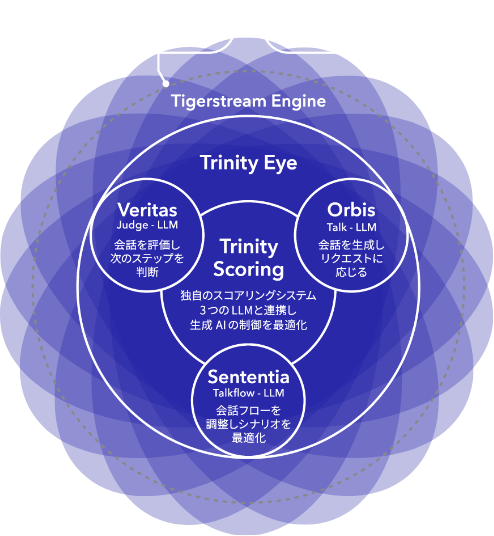
Tigerstream Engine
An LLM-based conversation system that efficiently processes data and generates quick responses.
Trinity Eye
An integrated system where three LLMs—Orbis, Veritas, and Sententia—collaborate. It provides high-precision dialogue flow, evaluation, and purpose-driven judgment as a platform for superior communication and decision-making.
-
Orbis = Talk - LLM
Generates dialogue and responds to user requests.
-
Veritas = Judge - LLM
Evaluates dialogue and determines next steps based on user intent and sentiment.
-
Sententia = Talkflow - LLM
Adjusts conversation flow in real time and optimizes scenarios.
It is designed with a new approach: “AI selects and nurtures AI,” instead of the traditional model of “humans using AI.”
Distinct from other agent platforms and frameworks, it has five innovative differentiators.
-
1. Meta-structure where AI evaluates and selects AI
While other systems depend on human-designed rules, this system lets AI select optimal collaborators based on outcomes—enabling self-judging orchestration with “evaluate → select → improve.”
-
2. Multi-axis scoring by the Judge layer
Outputs are automatically scored across eight evaluation axes (achievement rate, factuality, safety, etc.). It quantitatively determines which AI is best suited to respond—not just calling any AI.
-
3. Dynamic optimization with vectors × graph DB
By combining semantic similarity (vectors) and performance data (graph), the system automatically selects the most effective agent group for each task. This is a unique “learning routing” approach.
-
4. A self-improvement loop that gets smarter with use
Dialogue and task results are learned as KPIs, continuously strengthening accuracy, efficiency, and judgment. The entire AI network evolves over time—an AI foundation that grows with experience.
-
5. Standards compliance and high safety
MCP connectivity enables integration with diverse tools and data. Policy controls and auditing features build a safe and transparent AI collaboration environment.

Space “thinks,” AI “guides.”
What OFFICE AGENTIC AI brings to the office
The first step of a co-creation project
powered by patented technology
As work styles diversify and the balance between creativity and efficiency becomes essential, offices are no longer just “places to work.” People and AI understand each other, encourage action, and the environment itself functions as part of cognition—evolving into an intelligent, responsive space. TIGEREYE Inc. and KOKUYO Co., Ltd. are developing the next-generation office platform “OFFICE AGENTIC AI” to realize this new vision. The platform enables AI to understand human movement, emotions, and task flows in real time, optimizing coordination among space, information, and devices. It aims for an office where people and AI work together—unlocking creativity and focus for each individual.
“OFFICE AGENTIC AI” is a fusion of TIGEREYE’s multimodal AI and KOKUYO’s spatial design philosophy for an “Autonomous Collaborative Society.” The office itself becomes an entity that learns relationships with people, makes proposals, and guides action.
Example Experiences
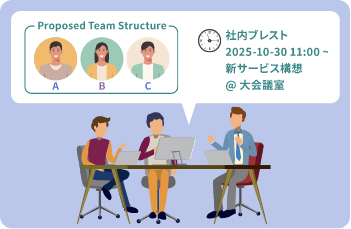
Propose optimal meeting times and team compositions based on past conversation data
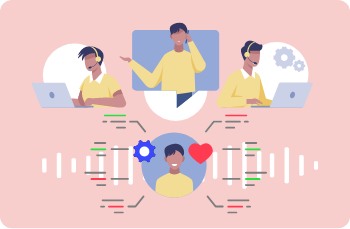
Analyze work patterns to support productivity and stress reduction
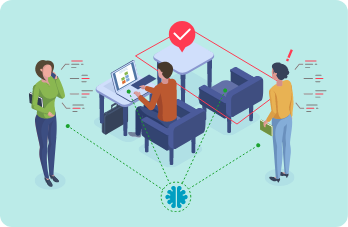
Optimize seating layouts and workflows across the space in real time
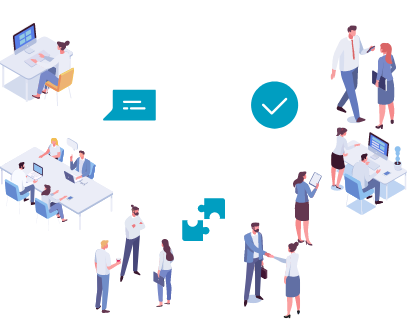
Autonomous Control with a Three-Layer Structure
-
 Talk layer
Generates natural dialogue with users and other AI
Example: proposing meetings with employees, summarizing meeting content -
 Judge layer
Scores and evaluates the purpose and quality of dialogue and actions
Example: understanding intent in statements, scoring motivation -
 Match layer
Recommends and assembles optimal AI agents and personnel
Example: proposing optimal project teams, supporting task assignments
The office becomes a “thinking partner,” supporting creative work.
“OFFICE AGENTIC AI” is planned for validation in the following areas.
- - Meeting room reservations and scheduling optimization
- - Integration and optimization with attendance and access data
- - Monitoring internal well-being and stress
- - Optimized support for information sharing and team building
Ultimately, it will become an AI platform that understands each employee’s emotions, goals, and behavior—updating the way people work itself.