Turn AI speed into a system your team can operate.
Keep the speed of AI-driven development while automating and standardizing code quality, reviews, merges, and CI/CD. An operational foundation that scales from 10,000 to 100,000 lines of code while maintaining quality.
Three Quality Areas That Make AI Development Sustainable
Code Quality
Continuously detects duplicate AI-generated implementations, unnecessary dependencies, and growing complexity to prevent maintenance costs from increasing.
Process Quality
Standardizes review criteria, merge conditions, and Hotfix/Revert decisions so the whole team can maintain development quality.
Operational Quality
Automates CI/CD, staging, smoke tests, and production approval to enable safer releases.
Diagnose your codebase and visualize improvement opportunities
In about three business days, we analyze risky code, unnecessary dependencies, duplicate implementations, and areas that have become overly complex, then return the findings as a PDF report. There is no cost.
Risk Diagnosis
Visualize duplication, complexity, and unnecessary dependencies
Improvement Priority
Prioritize areas with the greatest improvement impact
Maintainability Assessment
Forecast future technical debt and maintenance costs
Improvement Proposals
Present concrete actions for improvement
From issue discovery to improvement proposals, we diagnose your codebase for free.
Why Now
The challenges of AI-driven development appear a few months later.
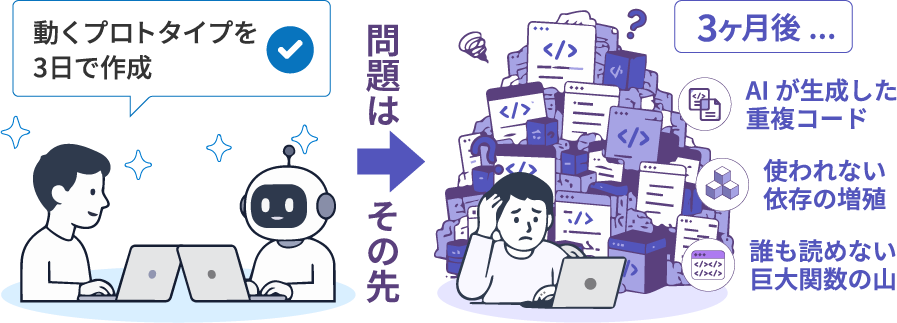
With today's AI, a working prototype can be built in three days. The real issue comes after that.
When a system built in three days needs to be expanded three months later, teams can find themselves buried under AI-generated duplicate code, unused dependencies, and giant functions that no one can read. Once the codebase exceeds 10,000 lines, human review alone can no longer keep up. Beyond 30,000 lines, everyone starts thinking it would be faster to rewrite it.
The problem is not that AI was used. The problem is the absence of governance designed for development that assumes AI will be used.
Problems in the Field
What is actually happening in teams using AI.
Code Quality Breakdown
- Duplicate code and bloated dependencies
Because AI writes from scratch each time, the same functionality appears in multiple places and unnecessary libraries continue to accumulate. - Implementation without specifications
Teams build something that works for now, and the documentation becomes inaccurate by the next day. - Testing is deprioritized
AI can write working code, but tests are postponed and regressions are discovered in production. - Suppression comments left behind
// eslint-disable and # noqa are added as temporary suppressions and remain six months later.
Process Breakdown
- Unreviewable pull requests
AI generates 2,000 lines at once. Reviewers can do little more than approve, and code is effectively merged unchecked. - Direct operation on main
No review and no automated verification. Production releases depend on luck. - Broken merge operations
squash, merge, and rebase are mixed, history becomes unreadable, and AI can merge its own pull requests as-is. - Hotfixes create the next incident
CI is skipped because the issue is urgent, and the fix causes another failure.
AI-Specific Issues
- Overconfidence in AI
AI's confident mistakes, or hallucinations, are merged without verification, and teams realize in production that no one had actually read the code. - Loss of context
Every new session requires another 30 minutes of context reconstruction. - Failed pair programming
"Pair programming with AI" becomes AI writing code while humans simply approve. Roles and handoff rituals are never defined. - Secrets in commits
API keys and connection strings are casually committed, and apology messages plus emergency rotations become routine.
Framework
Support quality management with both people and AI.
The issue is not that AI development is too fast. The issue is that teams are still trying to manage AI-generated code quality at human speed.
AI-Driven Development Framework is a mechanism for automating and standardizing quality management itself. It works when five elements are in place: three layers of code quality (prevention, detection, cleanup) and two pillars of process quality (pairing and merge gates).
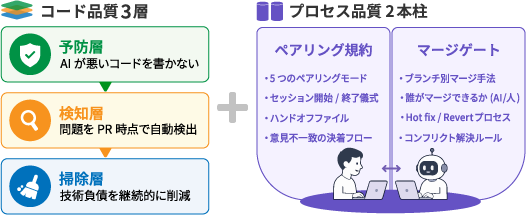
Five Quality Layers
Manage development from design to merge.
Prevention Layer
Define rules before AI writes code. CLAUDE.md and AGENTS.md prevent duplication, unnecessary dependencies, and debug code from being introduced.
Detection Layer
CI automatically detects dead code, unused dependencies, giant functions, and duplicate code before review.
Cleanup Layer
Technical debt grows when left unattended. Weekly audits and cleanup pull requests reduce it continuously.
Pairing
Quality cannot be guaranteed when AI writes and humans only approve. Roles, start and end procedures, and handoffs are turned into a protocol.
Merge Gates
Not everyone should be able to merge into main at any time. Merge conditions and responsibility are made explicit.
Cost Reduction
Why development costs can be reduced
The issue is not that AI development is too fast.
The issue is that teams are still trying to manage AI-generated code quality at human speed.
Mechanical judgments are moved into CI, allowing people to focus on design and decision-making.
In addition, a four-stage process of impact analysis, staging, smoke testing, and production approval helps reduce production-related incidents.
Review Effort
Estimated based on TIGEREYE's assumed case60 min -> 15 min
CI absorbs mechanical findings such as duplication, dead code, unused dependencies, and complexity. Human reviewers can focus only on design decisions and business logic.* Approximate average review time per pull request
Production Incident Cost
Estimated based on TIGEREYE's assumed case-50 to 70%
A four-stage flow of impact analysis, automatic staging deployment, smoke testing, and manual production approval helps suppress release-related incidents.* Comparative observation with and without a governance layer
Technical Debt Cost
Estimated based on TIGEREYE's assumed case-60 to 80%
Weekly Code Health Audits detect and reduce debt before it accumulates. When scaling from 10,000 to 100,000 lines, teams can avoid the full rewrites that would otherwise become necessary.* Estimate based on continuous reduction through weekly audits and cleanup pull requests
Onboarding
Estimated based on TIGEREYE's assumed case-50%
By reading CLAUDE.md, AGENTS.md, and STATUS.md, new members, both human and AI, can become productive from day one. Tacit, person-dependent practices disappear.* Shortened ramp-up period through rule documentation
Case Study
Enterprise System Development with AI-Driven Development
An enterprise intranet AI system used by approximately 10,000 people was released to commercial production in about seven weeks by using AI-supported design, AI-supported implementation, and quality assurance processes.
It is a large-scale system integrating multiple business systems, including AI chat, facility reservations, visitor management, Google Workspace integration, authentication infrastructure, and an administration portal.
approx.10,000
Users
approx.7weeks
Development Period
approx.250,000LOC
Code Size
1,700+
Commits
In this project, AI was not used merely as a code completion tool. It was embedded across the entire development lifecycle.
-
STEP 01
AI Design Support
API design / DB design / class design / sequence design
-
STEP 02
AI Implementation Support
Backend generation / frontend generation / SQL generation / migration generation
-
STEP 03
AI Quality Assurance
Code review / test generation / security review / static analysis
-
STEP 04
Commercial Production Operation
CI/CD / pull request verification / release / operational improvement
AI Usage Areas
Quality Assurance Process
Conventional development: approx. 6 to 14 months
AI-driven development: approx.
7 weeks
Productivity improvement: approx.
4 to 8x
The success factor in this case was that the project was designed not as simple code generation, but as AI-driven development that incorporated both AI-powered development and multi-stage AI quality assurance. By combining AI code review, AI test generation, AI debugging, CI/CD, and automated quality checks, the team achieved a commercial production release in a short period of time.
We can support your development as an AI-driven development partner.
We share analysis results and support everything from improvement roadmap planning to framework implementation and development outsourcing.
Reality Check
Benefits and Tradeoffs
Benefits
- Initial development 3 to 5 times faster: with specification-driven development and parallel pair sessions, functionality that used to take two weeks can work in three to five days.
- Development costs cut in half: combined effects across rework, reviews, failures, technical debt, and onboarding.
- Large-scale operation with a small team: a five-person team can maintain a 50,000 LOC SaaS product.
- Code does not decay: even when growing from 10,000 to 100,000 lines, a full rewrite is not required.
- Documentation is produced as a byproduct: specifications, decisions, debt, and pair sessions are naturally documented.
- AI usage is not person-dependent: the same process can be reused across projects.
- Audit readiness: who approved and merged, whether human or AI, can all be traced.
Tradeoffs and Prerequisites
- Initial setup cost: half a day for new projects, one day plus one to two weeks of team adaptation for existing codebases with tens of thousands of lines.
- Process discipline is required: if the culture allows pushing with --no-verify because it is easier, no system will be effective.
- CI execution time and fees increase: code-health checks add 3 to 10 minutes, and Actions fees may increase by several hundred to several thousand yen per month.
- False-positive tuning period: suppression maintenance for knip, vulture, and jscpd takes one to two weeks.
- Dependence on AI services: productivity drops when Claude, Cursor, or Actions has an outage.
- Cultural resistance from senior engineers: reactions such as "letting AI write code is unacceptable" are real. Adoption must be designed carefully.
- Hallucinations will not become zero: reviewer AI plus human double checks absorb the risk, but cannot eliminate it completely.
Fit
Organizations where this framework is effective
Good Fit
- Development organizations already using AI but lacking governance
- Medium-scale SaaS products and business systems with tens of thousands to hundreds of thousands of lines of code
- Startups that want to move quickly with a small team of two to ten people
- Teams aiming to revive or extend the life of an existing product
- Development companies that want to balance quality and speed in contract development
- Information systems departments where AI governance has not caught up with internal tools and DX initiatives
Not a Good Fit
- Organizations with a culture that bans AI
- Scripts or proof-of-concepts that are complete within a few hundred lines
- Enterprise organizations with more than 100 engineers, which require separate integration design with existing processes
- Legacy systems scheduled to be retired within six months
- One-off projects or short engagements of less than one month
Package
What we set up during implementation
Based on your project status, we design and implement AI development rules, quality gates, CI/CD, and review operations. The following are typical support items.
AI Development Rule Design
- Define what AI can handle, prohibited actions, and checks required before implementation
- Prevent duplicate implementation, unnecessary dependencies, and debug code contamination
Development Process Design
- Standardize roles for AI and humans, review criteria, and handoff methods
- Design how pair sessions start, end, and are recorded
Quality Gate Setup
- Automate pull request quality checks, duplicate code detection, and unused dependency detection
- Continuously monitor complexity, huge pull requests, and suppression comments
CI/CD Setup
- Prepare staging, automated tests, smoke tests, and production approval flows
- Document decision criteria and safeguards for Hotfix and Revert operations
Technical Debt Management
- Design weekly code audits, improvement priorities, and cleanup pull request operations
- Visualize future maintenance costs and reduce them continuously
Template Preparation
- Turn decision criteria for pull requests, issues, hotfixes, and reverts into templates
- Organize person-dependent tacit rules into a reusable team format
* Actual deliverables are designed individually according to repository structure, development organization, existing CI/CD, and AI tools in use. When necessary, we prepare AI rule files, pull request templates, GitHub Actions, technical debt management documents, and related materials.
Analysis Flow
How the free analysis works
We first analyze your current codebase and visualize where technical debt and operational risks are hidden.
You can decide whether to introduce the framework after reviewing the report.
- STEP 01 Analysis Request Apply through the form and share a GitHub repository or ZIP file
- STEP 02 Access Sharing Grant read-only access so we can review the codebase in a secure environment
- STEP 03 Code Analysis Analyze duplicate code, unused dependencies, complexity, and pull request operations
- STEP 04 Report Creation Organize improvement priorities and prepare a PDF report within three business days
- STEP 05 Improvement Proposal and Development Support Share analysis results and support everything from improvement proposals to implementation and development
Free Analysis (Three Business Days)
- Share a GitHub repository or ZIP file
- Analyze code quality, dependencies, duplication rate, and complexity
- Create an executive summary and technical details report
- Deliver a PDF report
- Implementation support and development support are also available on request
Support After Analysis
- Framework implementation support
- Existing codebase improvement
- Technical debt reduction projects
- AI development organization setup
- CI/CD setup
- AI-driven development support
Free Analysis
Visualize the risks hidden in your codebase.
In three business days, we analyze risky code, unnecessary dependencies, duplicate implementations, and areas that have become overly complex, then return the findings as a PDF report. There is no cost.
What the analysis reveals
- Dead code: line counts and top files for dead exports and unreachable branches
- Unused dependencies: number of removable libraries and estimated size reduction
- Duplicate rate: top 10 duplicate areas and overall ratio
- Complexity hotspots: functions with cyclomatic complexity (CCN) over 10
- Merge health: number of self-approved pull requests, average reviewers, and Hotfix ratio
- Huge pull request rate: ratio of pull requests over 500 lines, roughly the unreviewable PR rate, and expected improvement
- Reduction estimate: estimated reduction in LOC, dependencies, and build time
Deliverables
- PDF report: one-page executive summary plus technical details for engineers
- Raw data (CSV / JSON): a data set your team can use for deeper analysis
- 30-minute explanation meeting (only if requested)
What we need
- Read-only access to your GitHub repository or a ZIP upload
- No advance preparation required
FAQ
Frequently Asked Questions
Can you support monorepos?
Yes. We can also analyze individual subdirectories.
Can you analyze codebases larger than 100,000 lines?
Yes. If more time is required, we will let you know when you apply. The usual extension is two to three business days.
Will code or analysis data be taken outside the company?
Code is copied only to an isolated environment during analysis and deleted within 72 hours after the report is submitted. NDA support is also available.
Will it conflict with our existing CI/CD?
No. It is designed to run in parallel with existing workflows. Checks that are out of scope are skipped automatically.