We have filed a patent (Application No. 2025-035944) for the "Context-Adaptive AI Avatar / Chatbot," which adapts to the user's conversational context and generates optimal, intent-driven responses. We are now launching the TIGEREYE MULTI MODAL AI PLATFORM (TIGEREYE MM AI PF) equipped with this technology.
What is the Context-Adaptive AI Avatar / Chatbot?
The Context-Adaptive AI Avatar / Chatbot features an innovative capability that dynamically adjusts the AI chatbot's responses using LLM (Large Language Model) technology, enabling intent-driven conversations through camera-based facial expression analysis and automatic detection of the conversational flow. This makes it applicable across a wide range of fields, including sales, customer support, education, healthcare, and robot interfaces.
AI Avatar Interface (Conversation via Avatar)
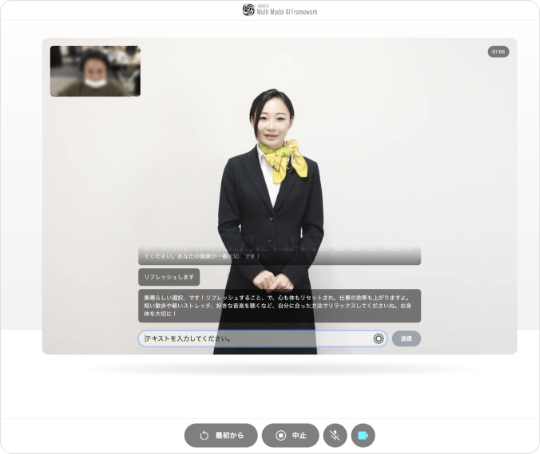
Photorealistic Avatar
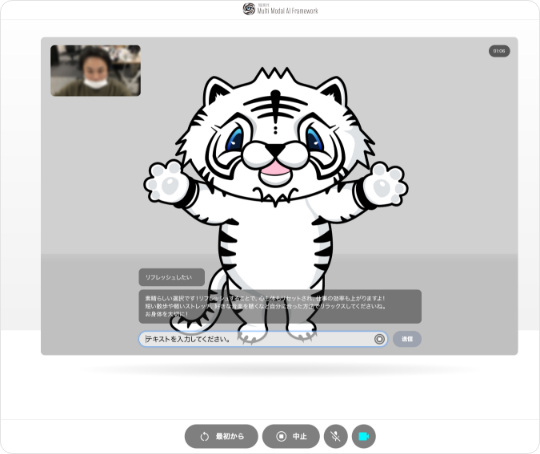
2D Avatar
Technology Overview
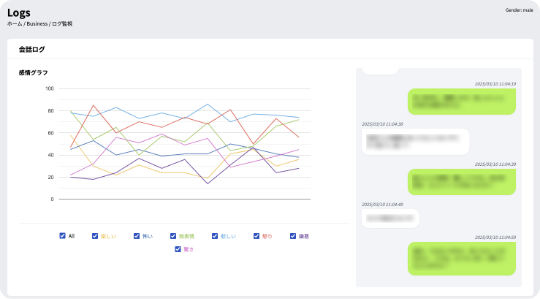
Emotion graph and conversation log
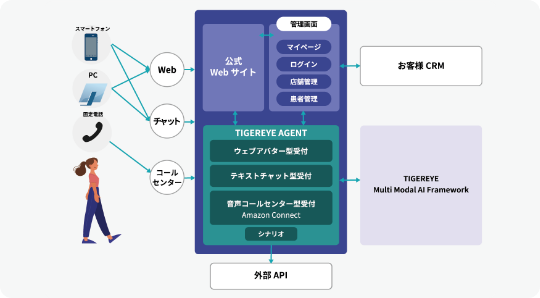
System delivery overview
This technology analyzes the user's emotions and level of understanding in real time, enhancing the adaptability of the conversation. It offers the following features:
- • Analyzes the user's facial expressions via camera and converts them into scores (level of understanding, level of interest, emotional positivity)
- • Analyzes the conversational flow and automatically determines the appropriate dialogue stage (opening, needs assessment, closing, etc.)
- • Optimizes prompts based on the scores to adjust the output of the LLM (Large Language Model)
- • Improves user engagement based on emotion, level of understanding, and level of interest
- • Implemented on the TIGEREYE MULTI MODAL AI PLATFORM (TIGEREYE MM AI PF) and deployable across various AI avatars, robots, and chatbots
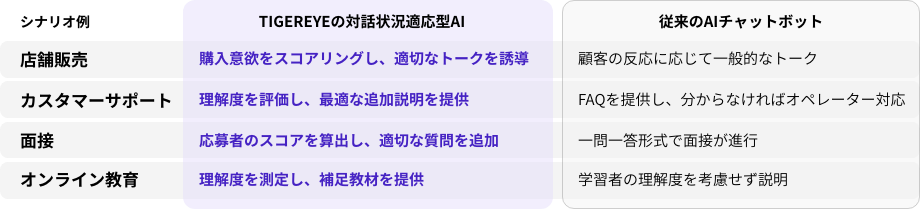
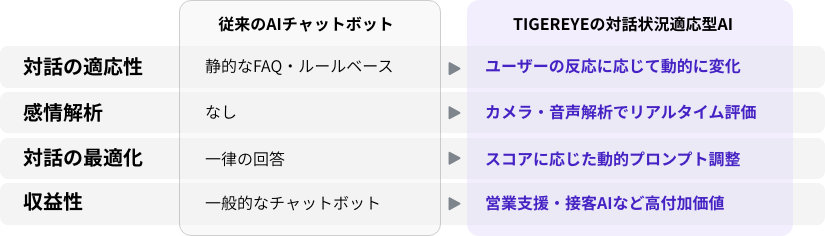
While conventional chatbots have been limited to simple text-based dialogue, this technology leverages the user's non-verbal information (facial expressions, reactions, and utterance content) to deliver intent-driven conversations, achieving more sophisticated communication.
Applicable Industries and Scenarios
Sales & Sales Support
• AI generates optimal sales talk tailored to the customer's level of interest
• Improves closing rates (adjusting the conversation to boost purchase intent)
• Enhances EC sites and online customer service
Customer Support
• Analyzes the user's level of understanding and emotions to present appropriate responses
• As an operator-support AI, improves response quality and reduces workload
Education & Training
• Analyzes learners' level of understanding in real time and provides appropriate feedback
• Enhances sales training, interview practice, and AI coaching
AI Avatars & Robots
• Achieves natural customer service and interaction through integration with AI avatars and reception robots
• Integration with robot interfaces such as Pepper and temi
Comparison with Conventional Chatbots
Delivery Methods
TIGEREYE leverages this technology and offers it through the following delivery methods.
SaaS Model
(Monthly subscription)
• For call centers, EC, finance, and healthcare
Custom Development
(Contract development for large enterprises)
• Advanced tuning tailored to corporate needs
Hardware Integration
• Collaboration with robot manufacturers (embedding into AI avatars and smart devices)
Achievable Use Cases and Scenario Examples
Use Cases
-
Education
Monitors students' level of understanding and concentration to adjust the pace of the lesson.
-
Medical Monitoring
Observes emotional changes and uses them to help improve psychological well-being.
-
Customer Support
Observes emotional changes and uses them to help improve psychological well-being.
-
Sales Support
Grasps customer interest in real time and supports appropriate proposals and responses.
Scenarios (Stages)
Specific conversation scenarios (sales talks, explanations of important matters, interviews, etc.) can be configured step by step, from opening to closing.
Example: Sales Support
- Step 1. Opening: Greeting and sparking interest
- Step 2. Needs Assessment: Listening to the customer
- Step 3. Product Proposal: Explaining the benefits
- Step 4. Handling Questions: Resolving concerns
- Step 5. Purchase Proposal: Encouraging a decision
- Step 6. Closing: Showing gratitude and setting up the next step
By analyzing user reactions, the conversation is optimized in real time.