

TIGEREYE Inc. (Head office: Chuo-ku, Tokyo; CEO: Gaku Kamimura) announces that it has updated its security solution built around the face recognition service “KAOPASS QR” and has begun offering it as a new authentication platform that aims to minimize the risk of false authentication.
Background | The problem of “false authentication” that has surfaced as face recognition spreads
While face recognition is being adopted in a wide range of areas such as entry and exit management, identity verification, and attendance management, operational issues have also been pointed out, including spoofing with photos and videos, misidentification of people who look alike, and recognition accuracy that varies with the usage environment. While many solutions focus on “improving recognition accuracy,” TIGEREYE sees false authentication as a design problem rather than an accuracy problem, and has redesigned authentication on the premise of structurally preventing false authentication.
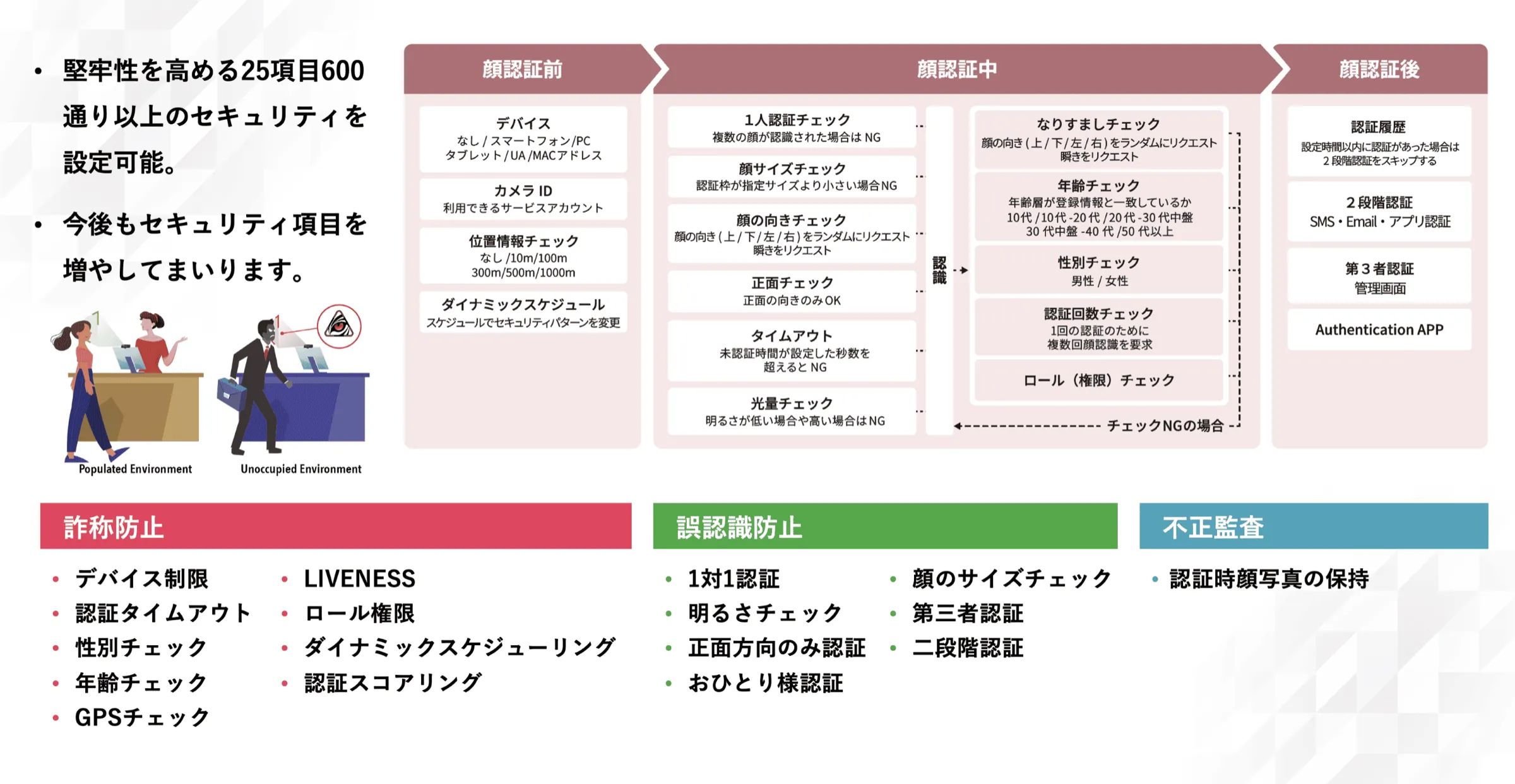
Features | A multi-layer authentication architecture that prevents false authentication
Rather than relying on a single authentication method, TIGEREYE SECURITY SOLUTION combines multiple authentication layers to achieve highly accurate identity verification.
Main functions and technical elements
- Liveness detection (passive / active)
Liveness detection that detects and blocks spoofing with still images or videos - One-to-one authentication
A mechanism that matches the face image captured at authentication one-to-one against the face data linked to the user’s ID, and does not complete authentication if the corresponding ID does not exist - Environmental condition checks
Assesses face orientation, brightness, number of people, device, GPS information, and more in real time - Authentication scoring and multi-factor authentication (MFA)
Automatically adds two-step authentication, third-party authentication, or administrator approval depending on the situation - Dynamic scheduling
Automatically switches authentication strength according to the day of the week, time of day, and usage scenario
New release: One-to-one authentication
With conventional one-to-many authentication, there was a risk that twins or people with very similar faces could be misidentified—for example, person A could be authenticated and clocked in as person B. One-to-one authentication prevents false authentication caused by this kind of misidentification.
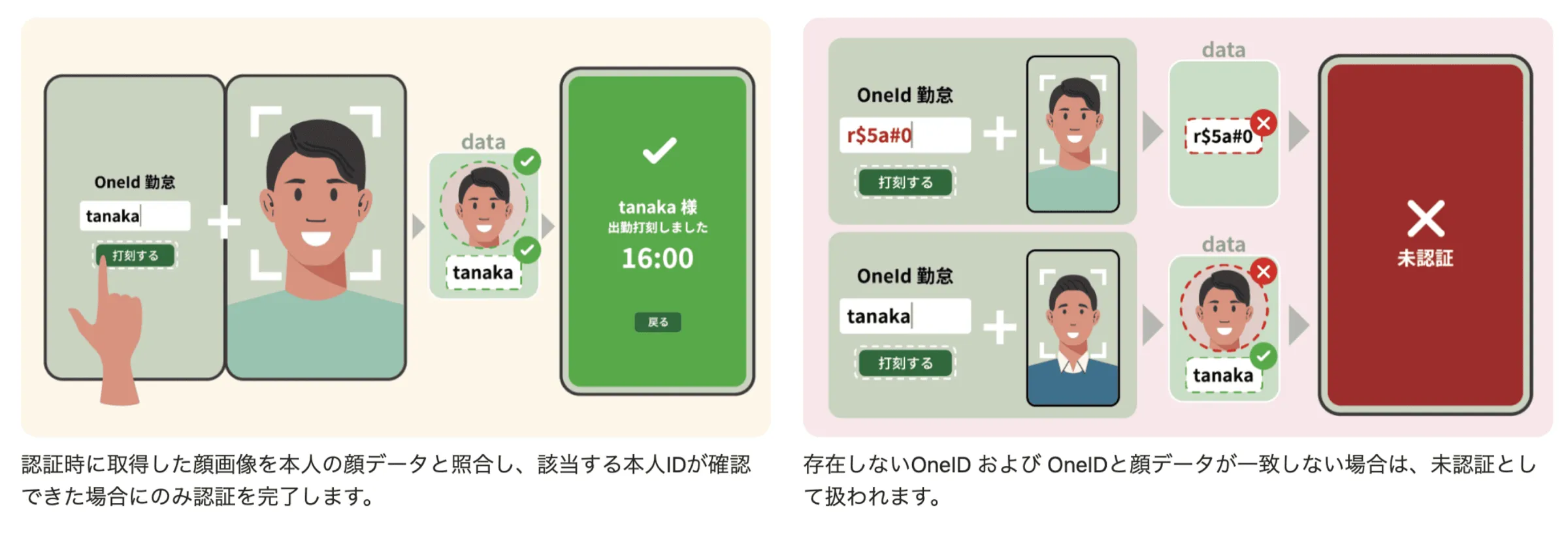
This function matches the face image captured at authentication against the “face data identified as the person” in the system, and completes authentication only when the corresponding personal ID is confirmed among them. This prevents false authentication under the ID of another person with a similar face and delivers more accurate identity verification.
Support for combined authentication | Flexible design to fit your operations
In this version, in addition to face recognition, combined authentication with vein authentication, IC card authentication, and other methods is available as an option. This allows flexible authentication design based on the risk level of each facility or operation.
Learn more
https://tigereye.ai/securitysolution/
Expected use cases
- Entry and exit management at offices and research facilities
- Identity verification and exam proctoring at educational institutions
- High-security environments such as medical and research facilities
- User authentication for web services and business systems
Future outlook
TIGEREYE will continue to help build the foundation for a safe and secure digital society by advancing authentication technology designed for real-world business use.
Start by telling us about the challenges you want to solve with AI
Toward workplaces where AI is simply part of everyday work.