
Dual OCR

Reads forms and documents and turns them into data
Dual OCR is a next-generation OCR that reads with an understanding of meaning.

Toward zero manual corrections.
A next-generation OCR
that reads with an understanding of meaning

Multiple AIs read the document, understand its meaning, and correct errors automatically.
With the power of "multiple OCRs × LLM," it changes what checking work looks like.
Dual OCR runs CNN-based OCR (fast and stable) and ViT/LLM-based OCR (for hard-to-read text and contextual correction) in parallel, and an LLM integrates their results through inference to determine the final result.
Its structured output also retains evidence (Provenance) and uncertainty (DiffMap), supporting both auditability and the automation of operations.
  • Jointly developed by TIGEREYE × KOKUYO
  • Patent pending (Application No. 2026-016437)
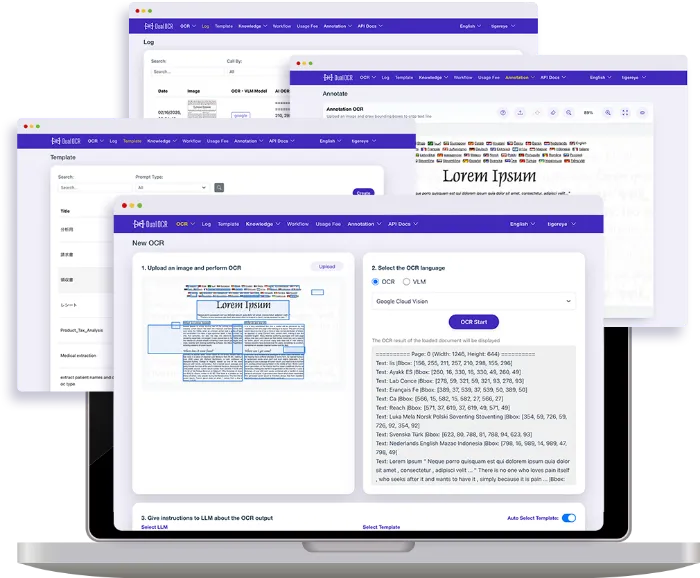
The Dual OCR screen, where you upload document images, read them, and check the results side by side

Dual OCR: beyond reading, an OCR that makes judgments

Problems companies face after adopting OCR

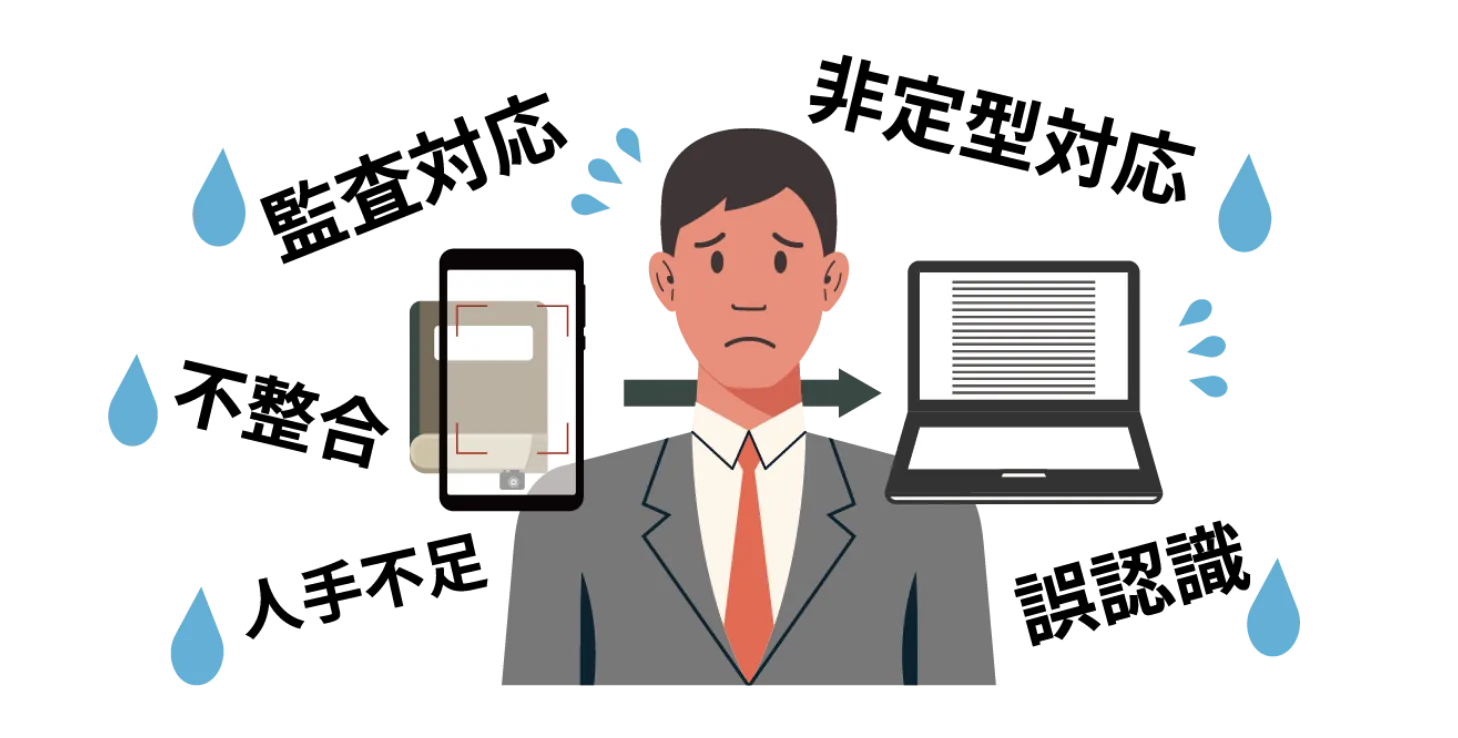
  1. Even at 99% accuracy, a 1% misrecognition can be critical (numbers, dates, digits)
  2. It can't read context, so it can't detect inconsistencies between fields
  3. It can't show its evidence, so audits take time
  4. In the end, human checks are still required, so costs don't come down
  5. Non-standard layouts, multiple languages, and handwriting become bottlenecks
Illustration of a person struggling with audits, non-standard documents, inconsistencies, staff shortages, and misrecognition

A design that delivers accuracy, automation, and auditability at the same time

Reads with two different OCRs
Using two types of OCR with different strengths at the same time keeps reading errors to a minimum.
AI review and final check
AI reviews the results in light of the context and rules of the entire document, and integrates them into the single most appropriate result.
Output in a ready-to-use format
Outputs data in a format that is easy to integrate with systems, along with location information and confidence scores.
Visualizes error-prone areas
Automatically detects and displays ambiguous fields, so you can see right away where a person needs to check.

Processing is separated into three layers

To deliver both reading accuracy and auditability, processing is divided into three layers.
A design that retains differences (DiffMap) and evidence (Provenance) supports both highly accurate automation and accountability.

  1. Extraction

    Runs multiple OCRs with different strengths (e.g., CNN-based models + ViT/LLM-based models) in parallel to generate reading candidates. Drawing on the strengths of each, it improves reading coverage.

  2. Inference and integration

    Combines an LLM with rule-based processing to check the consistency of context and format, and determines the final result. Rather than a simple majority vote, it chooses the best answer based on an understanding of meaning.

  3. Auditability

    Retains DiffMap (difference information) and Provenance (evidence information) to show which candidate the final result was derived from. It generates explainable output that can be used as is for audits.

Key features

  1. DiffMapVisualizes uncertainty with charGap / tokenGap / semanticGap.
  2. Cross InferenceInfers consistency across multiple documents to detect contradictions automatically.
  3. ProvenanceRetains recognition evidence, alternative candidates, and confidence levels to ensure auditability.
  4. Extraction and classificationExtracts fields from invoices, contracts, and forms, and classifies them automatically.
  5. TemplatesSaves OCR + inference conditions as workflows for reuse.
  6. API integrationDesigned for easy integration into existing business systems.
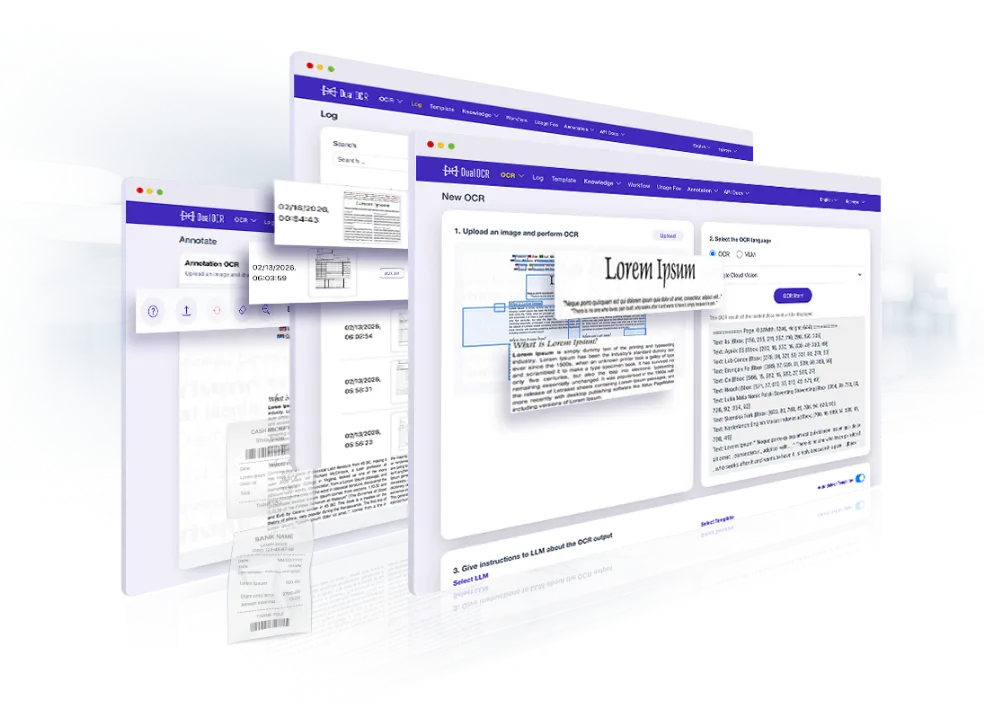
Dual OCR screens for reading, annotations, logs, and starting a new reading

Deployment options for your use case

Cloud
Well suited to API integration, scaling, and operational optimization, with flexible expansion to match your workload.
Edge
Supports closed, high-security environments, and runs reliably even in operations where data cannot leave the premises.

Use cases

Contracts and invoices (accounting digitalization)
Automates the entire process, from field extraction to journal entry integration.
Finance and screening (presenting evidence)
Presents the evidence needed for screening decisions.
Local government (high-volume forms and audits)
Handles high-volume processing and audit requirements at the same time.
Identity verification (KYC)
Checks multiple documents and detects contradictions.
Multilingual document management
Reliably processes documents that mix multiple languages through contextual understanding.
Business cards and receipts
Processes a mix of standard and non-standard inputs together.

How adoption works

  1. ConsultationWe organize your operational requirements and target forms, and define the challenges and goals.
  2. PoCWe verify accuracy with real data and clarify the scope that can be automated.
  3. OptimizationWe adjust engine selection, rules, and inference design to raise quality.
  4. IntegrationWe build it into your existing operations through API integration and workflow setup.
  5. DeploymentAfter you start using it, we keep running improvement cycles for continuous optimization.

Joint development with KOKUYO Co., Ltd.

KOKUYO's expertise in form-based work, and TIGEREYE's AI technology.
Together, these two strengths gave rise to a patent-pending technology: "Inference-Integrated OCR."
KOKUYO Co., Ltd., which knows Japanese form-based work inside out, joined forces with TIGEREYE, a developer of next-generation AI.
To solve the hard problems of form-based work, such as handwriting and complex layouts, the two companies jointly developed "Inference-Integrated OCR," a technology in which AI performs its own inference and correction.
The combined strengths of the two companies reduce the "final human check" in day-to-day work.

Patent pending (Application No. 2026-016437)

Start by telling us about the challenges you want to solve with AI

Toward workplaces where AI is simply part of everyday work.

Discuss Your Challenges