

01
Static routing
Flexible route selection is difficult
Toward a Future Where People and AI Work Together
KOKUYO × TIGEREYE Joint Patent Application and the "OFFICE AGENTIC AI" Project
About the patent application (Application No. 2025-180014)
The AI agent market is expanding rapidly and is projected to grow from approximately USD 5.1 billion in 2024 to about USD 47.1 billion by 2030 (CAGR: ~44.8%).
By 2025, companies will enter an era in which over 100 agents collaborate in operations, and AI will take a central role in real work—ushering in the "agent era."
However, existing systems face challenges such as static routing, lack of evaluation, and fragmented integrations, making it difficult to achieve optimal agent collaboration and governance.
To address this, we propose a new AI ecosystem where AI selects, learns, and improves other AI—enabling smarter collaboration.
Joint application by KOKUYO × TIGEREYE / Patent pending (Application No. 2025-180014)
2024
About USD 5.1 billion
2030 (projected)
About USD 47.1 billion
CAGR
About 44.8%
01
Flexible route selection is difficult
02
No mechanism to measure or improve quality
03
Individual implementations limit scalability
04
Insufficient auditability and explainability
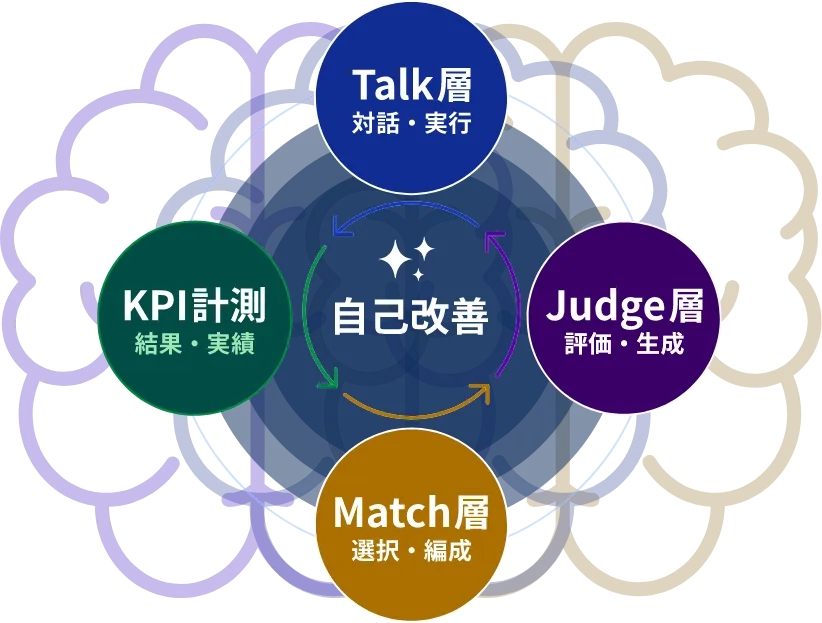
Three layers work together so AI can autonomously form teams and evolve through continuous learning.
This patent-pending technology (Application No. 2025-180014) is a three-layer autonomous system centered on the concept of "AI evaluates, selects, and learns from AI."
AI agents understand each other's strengths, form optimal teams, and share tasks based on context. Over time, they evolve into a smarter AI foundation.
With this mechanism, AI dynamically selects the best-performing combinations without human-defined rules. Each agent learns from execution results and accumulates collaboration data with other agents, continuously improving accuracy, efficiency, and adaptability.
TIGEREYE's proprietary technology for dialogue.
Three functions with distinct roles (Stage, Talk, HSI Judge) work together with Trinity Scoring, a scoring mechanism.
Rather than simply using an LLM, it evaluates the dialogue, shapes its flow, and dynamically controls the AI's responses toward achieving the goal.
Adjusts the conversation flow in real time and optimizes the scenario.
Automatically controls how the dialogue progresses according to its purpose.
Conversations with a set flow, such as sales pitches, explanations of important matters, and interviews, can be configured stage by stage, from opening to close.
Example: Opening → Confirming needs → Proposing products → Answering questions → Proposing a purchase → Closing
Generates conversation and responds to user requests.
It is the speaker in the dialogue, generating conversational text with an LLM.
It returns words suited to the moment, following the next step and flow decided by HSI Judge and Stage.
An AI model developed in-house by TIGEREYE that handles judgment in dialogue.
Beyond judging whether an answer is correct, it evaluates "Does this action align with the goal?", "What will happen next if it is carried out?", and "Should it be carried out, given the risks?", then decides the next step.
A proprietary scoring mechanism.
It works with the three functions to optimize control of generative AI.
A camera reads facial expressions and scores understanding, interest, and emotional positivity.
Prompts are adjusted to match those scores, shaping the LLM's output.
It is designed with a new approach, "AI selects and nurtures AI," instead of the traditional model of "humans using AI."
01
While other systems depend on human-designed rules, this system lets AI select optimal collaborators based on outcomes—enabling self-judging orchestration with "evaluate → select → improve."
02
Outputs are automatically scored across eight evaluation axes (achievement rate, factuality, safety, etc.). It quantitatively determines which AI is best suited to respond—not just calling any AI.
03
By combining semantic similarity (vectors) and performance data (graph), the system automatically selects the most effective agent group for each task. This is a unique "learning routing" approach.
04
Dialogue and task results are learned as KPIs, continuously strengthening accuracy, efficiency, and judgment. The entire AI network evolves over time—an AI foundation that grows with experience.
05
MCP connectivity enables integration with diverse tools and data. Policy controls and auditing features build a safe and transparent AI collaboration environment.
The first step of a co-creation project powered by patent-pending technology
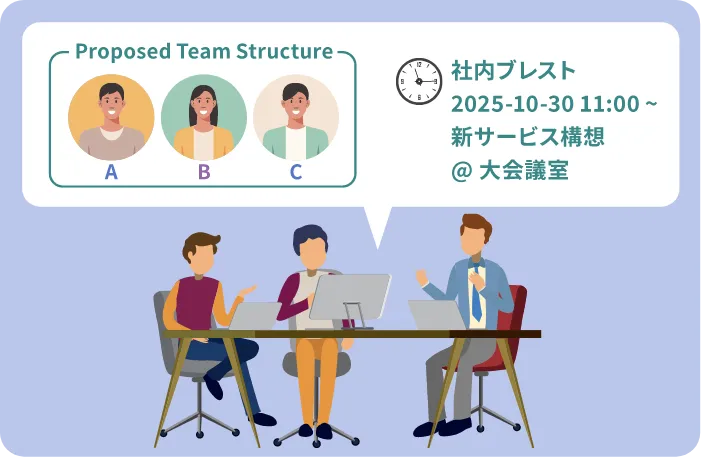
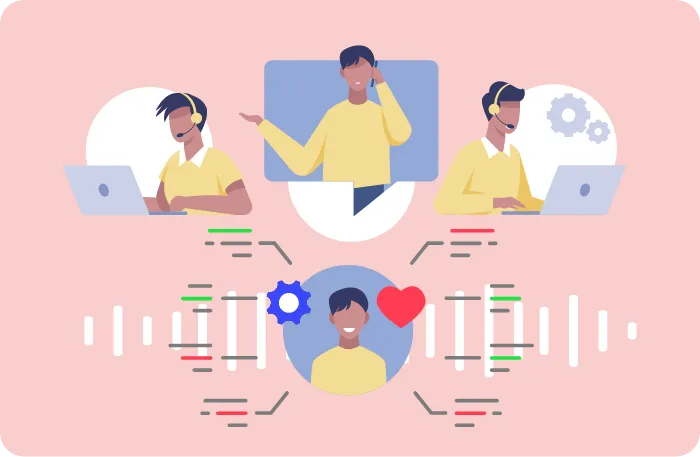
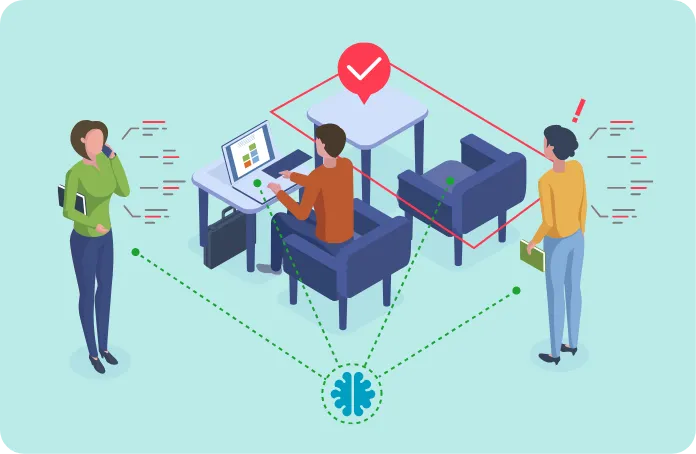
As work styles diversify and the balance between creativity and efficiency becomes essential, offices are no longer just "places to work." People and AI understand each other, encourage action, and the environment itself functions as part of cognition—evolving into an intelligent, responsive space. TIGEREYE Inc. and KOKUYO Co., Ltd. are developing the next-generation office platform "OFFICE AGENTIC AI" to realize this new vision. The platform enables AI to understand human movement, emotions, and task flows in real time, optimizing coordination among space, information, and devices. It aims for an office where people and AI work together—unlocking creativity and focus for each individual.
"OFFICE AGENTIC AI" is a fusion of TIGEREYE's multimodal AI and KOKUYO's spatial design philosophy for an "Autonomous Collaborative Society." The office itself becomes an entity that learns relationships with people, makes proposals, and guides action.
01
02
03
"OFFICE AGENTIC AI" is planned for validation in the following areas.
01
02
03
04
Ultimately, it will become an AI platform that understands each employee's emotions, goals, and behavior—updating the way people work itself.
Toward workplaces where AI is simply part of everyday work.